





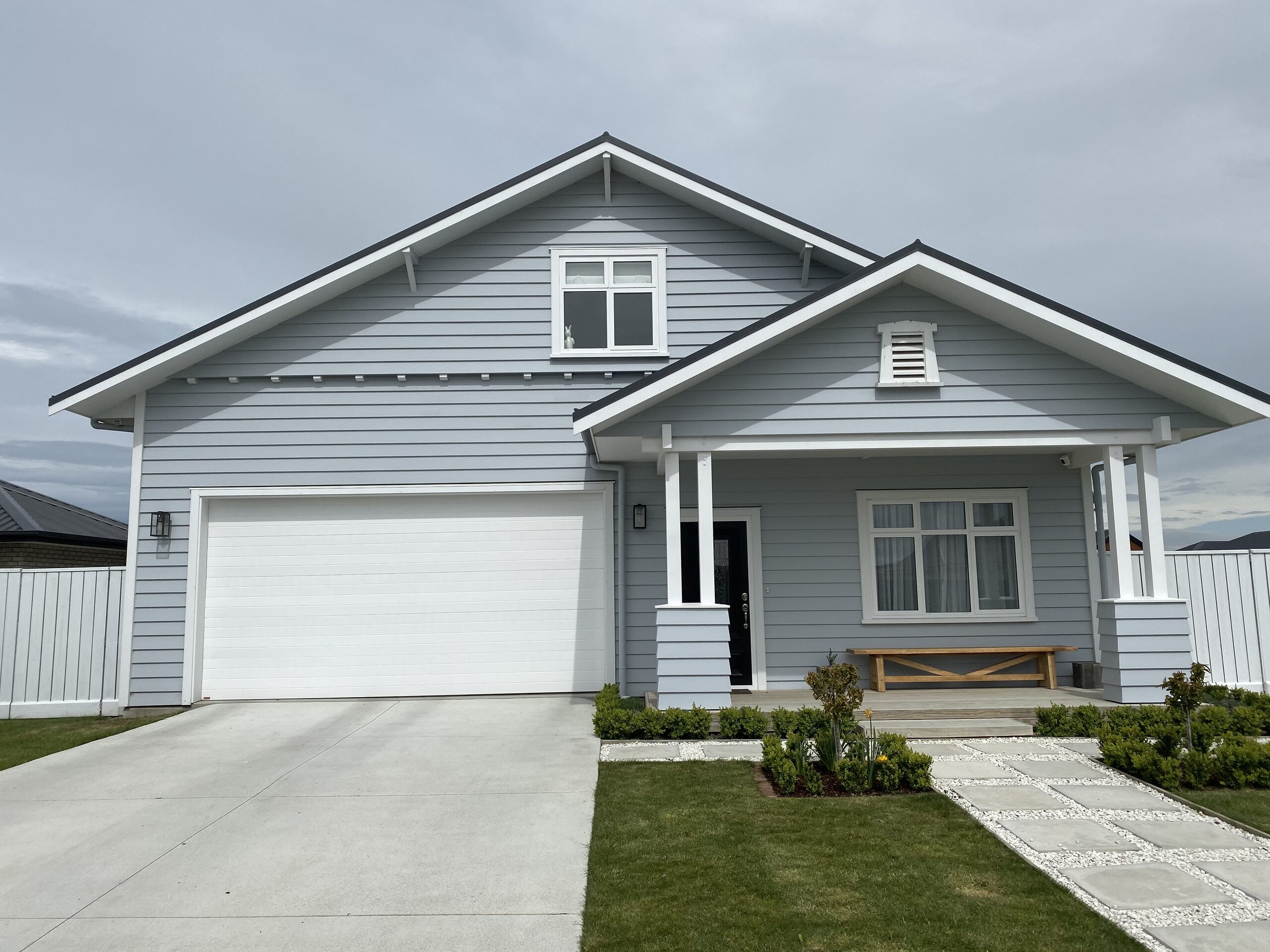
Building a character home in Rolleston or Selwyn starts with the section, because most of the district's new sections are too small to carry one. Selwyn has been New Zealand's fastest growing territorial authority on Stats NZ's subnational population estimates, reaching an estimated 87,600 residents at June 2025, and its quarterly new-dwelling consent numbers are running at the high end of the district's history. Nearly all of that supply is aimed at compact lots.
Heritage Homes builds new character homes — villas, bungalows and cottages — across Canterbury, and in this district the section decides the design. Below is the shortlist across Rolleston, West Melton and Prebbleton in Selwyn, plus Rangiora in Waimakariri and Halswell in Christchurch City, and the three things that decide whether a period design can go on one: building ties, covenants, and the ground under your lot. Sizes and availability move, so confirm each figure with the developer or agent.
Why most new Selwyn sections are too small for a villa
The planning settings explain the shortage. Selwyn District Council notified Variation 1 to the Proposed Selwyn District Plan on 20 August 2022, and its medium density residential standards took immediate legal effect for relevant residential sites in Rolleston, Lincoln and Prebbleton. Rolleston's outline development plans carry minimum net density targets, and the proposed Westhaven rezoning is medium density too.
Growth has run the same way: Stats NZ's estimates for the year to 30 June 2024 put district growth at 3.9 per cent, Rolleston at 9.6 per cent, Lincoln at 8.1 per cent and West Melton at 4.9 per cent — a faster year than the most recent one, which is part of why stage releases and section sizes keep shifting. A villa needs frontage and a setback to read properly, which makes it a 700 m²-plus proposition — our villa house plans show the footprints.
Rolleston, West Melton, Prebbleton and Rangiora subdivisions with large sections
| Subdivision | Section sizes, and how it sells |
|---|---|
| Faringdon, Rolleston | Chilton Quarter around 430–672 m²; the 700–1,000 m² low density band sits in the consented development plan, not a current release. Covenants, a builder panel, published stage geotechnical reports. |
| Te Whaiawa, West Melton | 109 sections; stage 1 titled at 582–747 m², stage 2 at 501–980 m². Ngāi Tahu Property and Mike Greer Homes: land only with design control, some lots turn-key. |
| Bellgrove, Rangiora | Standalone build sections across a wide size range, stage 3 the current release; our section data tops out well below 1,000 m², so get the current stage plan from the agent. Waimakariri consenting, and our research indicates no building ties, so confirm in writing that you can use your own builder. |
| Hampton Grove, Prebbleton | 127 sections, 337–515 m², titled. Guidelines, approval process and design form published with the covenant and geotechnical files. Village cottage scale. |
| Halswell Country Estates | 25 lots, 400–803 m², most sold. Christchurch City consenting, written developer approval before consent, a low-pressure sewer per lot. |
| Westhaven, Rolleston | Not selling. Variation 5, notified 25 February 2026, proposes medium density rezoning and remains in process; any first stage depends on that outcome, so treat indicated lot counts and dates as the developer's expectation rather than something to plan a build around. |
Te Whaiawa is the strongest current fit, at an upper end near 980 m². Faringdon's pages are patchy, so take sizes from the sales team; Wilfield Rise at West Melton, which had exactly this land, has sold out. Run the standard section checks early.
Building ties: is the section land only, or house and land?
A building tie means the section and the house are sold as a single contract, so the answer decides whether you can bring your own builder to the lot. It is a difference in how the land is sold, not a comment on anyone's workmanship, and in the Rolleston and Selwyn releases it takes three forms.
- House and land package. The developer or a partner builder holds the land and build contracts as one conditional transaction. You get a single contract price and one point of contact, subject to that contract's own variation and escalation clauses, but cannot bring a different builder to that lot.
- Land only. You take title to the section and contract your own builder separately.
- Design guidelines. These sit on top of either structure and govern the look of the house, not who builds it.
Three questions to the agent settle it: is this lot land only or a package, is there an exclusive panel of approved builders, and must the design be developer-approved before consent is lodged? Ties give developers delivery certainty and a consistent streetscape. Te Whaiawa's own material indicates no constraint on which building company you use, provided the design is approved first — get that confirmed in writing for your lot number before you go unconditional, because terms differ between stages.
TC1 land in Rolleston does not settle the foundation question
Much of Rolleston is mapped TC1 rather than TC3, so the ground story here is usually not a liquefaction scare — but the category is set per property, not per town. Published subdivision investigations in Rolleston have assessed land there as Canterbury Technical Category 1, in areas mapped as damaging liquefaction unlikely.
What bites is what TC1 leaves open. Published subdivision investigations in this area record site subsoil Class D — deep or soft soil — under NZS 1170.5:2004 and map buried paleo-channels of silt and sand, so two neighbouring sections in one TC1 subdivision can need different foundations, and site-specific testing is still required at building consent to confirm bearing capacity.
So ask for three documents by lot number before going unconditional: the stage's geotechnical completion report, the engineered fill certificate, and the test-pit or paleo-channel mapping. A villa has a long foundation line, and a buried channel under one corner becomes a cost after the contract is signed.
Technical categories are mapped property by property, not town by town. Much of Rolleston is TC1, while TC2 and TC3 land occurs elsewhere in greater Christchurch, including parts of Halswell and the Waimakariri towns, so check the category for the actual section on Canterbury Maps or the council property file rather than assuming the subdivision's reputation. Our concrete slab versus timber floor comparison covers the choice that follows.
Covenants, wind zone and H1: the checks that shape the design
Three specification questions decide what can be built, in this order of risk.
- Covenants, first and hardest. Covenant schedules routinely set minimum floor areas, approved cladding palettes and a contemporary design language, and some exclude weatherboard character designs outright. Halswell Country Estates requires written approval of the dwelling before consent. Have your solicitor pull the title and covenant schedule, and get the design guidelines in writing, before the deposit. Our weatherboard cladding guide covers what an approved palette leaves out.
- Wind zone, from the right source. Under NZS 3604:2011 the zone comes from six steps: wind region, lee zone, ground roughness, site exposure, topographic class, then the zone from Low to Extra High, where Extra High is a 55 m/s design wind speed and beyond that needs specific engineering design. BRANZ calls its own mapped wind data experimental, and not the source to use where a site-specific calculation or current council map exists. The zone drives bracing, fixings and joinery.
- H1 insulation. Roof R6.6, walls R2.0, and windows lifted from R0.37 to between R0.46 and R0.50 depending on zone. A new build meets these as a matter of course, which is the plain answer to whether character homes are cold.
- Servicing. At the West Melton, Darfield and Leeston end of the district, wastewater, water supply and power runs sit in the build budget and vary section by section.
Craig and Carla Rogers, and the case for a new villa on the plains
Rolleston's origins are older than its houses. The town began in 1866 as the railway junction where the Midland Line leaves the Main South Line, and took its name from Canterbury's last Provincial Superintendent. Almost all of its built fabric postdates 2000, while the period architecture of this landscape survives a few minutes away in Lincoln's nineteenth-century timber church, St Stephen's.
The plains vernacular suits that setting: weatherboard, high ceilings, a deep verandah for a hot nor'west afternoon and a cold southerly change, corrugated steel on a simple gable — a form that needs a 700 to 1,000 m² section to read correctly.
Craig and Carla Rogers have been building with Heritage Homes since August 2016. Craig holds an Advanced Trade Certificate in Carpentry and over 20 years' experience, including Christchurch earthquake rebuild work — the relevant credential where the honest answer to a foundation question is a geotechnical report. The regional picture sits on our page for character home builders in Christchurch.
Preparation is the part you control at the council counter. MBIE reports that 64.3 per cent of building consent applications attract a request for further information, and that a complete application can be processed in as few as six working days against an average of about 25 working days. That is an argument for a full document set at lodgement, not for anyone's influence over the decision — our guide to the building consent process sets out what a complete application contains.
Frequently asked questions
Which Rolleston or Selwyn subdivisions have sections big enough for a villa?
Te Whaiawa at West Melton, in Selwyn district, is the strongest current fit, with stage two sections running up to about 980 square metres. Bellgrove at Rangiora, which is in Waimakariri district rather than Selwyn, releases standalone build sections across a range of sizes that has varied between stages, so ask the agent for the current stage plan. Faringdon at Rolleston has a 700 to 1,000 square metre low density band, but it sits inside the consented development plan rather than a release you can buy today, and Hampton Grove at Prebbleton tops out near 515 square metres. Sizes and availability change between releases, so confirm with the developer or agent.
What are building ties, and how do I find out whether a section has them?
Building ties decide who is allowed to build on a section. In a house and land package, common across the new Rolleston and Selwyn subdivisions, the developer or a partner builder holds both the land and the build contract, so you cannot bring a different builder to that lot. In a land only sale you take title to the section and contract your own builder. Ask the agent three things: whether the lot is land only or a package, whether an approved builder panel exists and is exclusive, and whether the developer must approve your design before you lodge a building consent.
Does TC1 land in Rolleston mean I do not need a geotechnical report?
No. Published geotechnical investigations for new subdivisions at Rolleston, in Selwyn district, have assessed land as Canterbury Technical Category 1 in areas mapped as damaging liquefaction unlikely, which is not the same as clearing your own section. Those investigations also record site subsoil Class D, deep or soft soil, under NZS 1170.5:2004 and map buried silt and sand channels, so two neighbouring sections in one TC1 subdivision can need different foundations. Site specific testing is still required at building consent to confirm bearing capacity. Ask the developer for the geotechnical completion report and the engineered fill certificate that cover your actual lot number.
Can a covenant stop me building a weatherboard villa in a Selwyn subdivision?
In effect, yes. Covenant schedules in new Rolleston and Selwyn subdivisions often set minimum floor areas, approved cladding palettes and a contemporary design language, and some developments also require written approval of your house design before you apply for building consent. Have your solicitor pull the record of title and the full covenant schedule, and get the design guidelines in writing, before you pay a deposit.
Who builds Heritage Homes character homes in Rolleston and Selwyn?
Craig and Carla Rogers hold the Canterbury licence and have been building with Heritage Homes since August 2016. Craig holds an Advanced Trade Certificate in Carpentry and over 20 years' experience, including Christchurch earthquake rebuild work. They build across Canterbury, including the Selwyn towns of Rolleston, Lincoln, Prebbleton and West Melton.
Talk to us about building in Selwyn
Prefer to talk? Call Heritage Homes on 0508 40 30 20 or email sales@hhomes.nz.